 SINCE 2010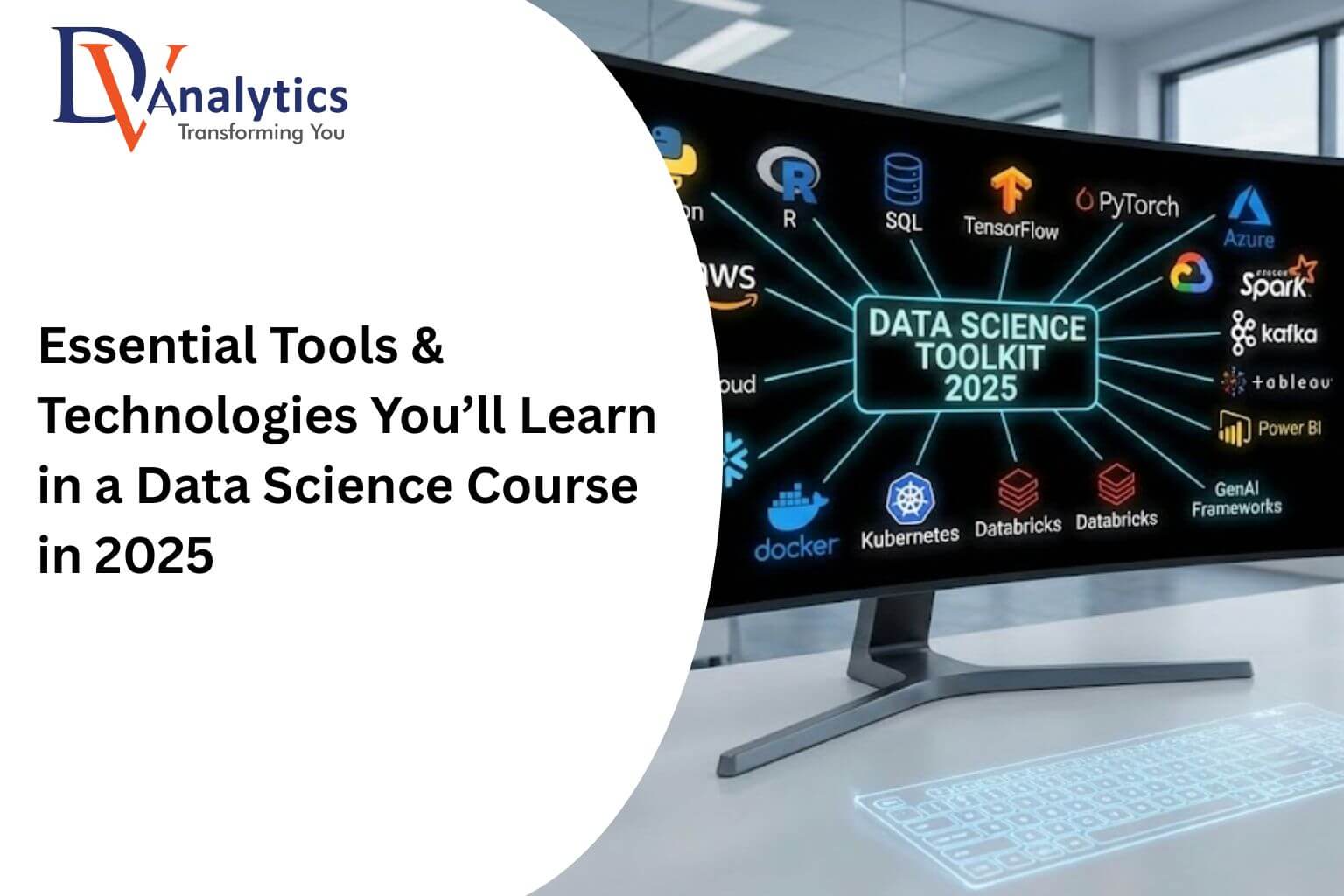
The field of data science has been evolving at a breakneck pace, as well as the tools which need data science to function. In the year 2025 and beyond, data-driven decision-making remains the key to shape decision making in various industries such as finance, healthcare, manufacturing, and e-commerce etc. To stay relevant across the dynamic domain, data professionals need to master a blend of programming, analytical, and visualization tools which enable them to churn out insights from complex datasets.
- Python: The Universal Data Science Language
Python is still the most central and adaptable programming language in data science. It is popular due to its simplicity, readability, and extensive ecosystem of libraries such as NumPy, Pandas, Scikit-learn, TensorFlow, and PyTorch etc.
In 2025, Python’s flexibility made it the centrepiece of things ranging from data preprocessing and visualization to machine learning and generative AI. The integration of Python with native cloud solutions and frameworks also eases scalable model deployment, which is an important skill for any aspiring data scientist.
- SQL: The Lifeblood of Data Handling
Though many modern technologies come and go, SQL (Structured Query Language) is one such timeless skill which is a must-have for any individual getting hands-on with data. Each data analyst and data scientist is expected to have the basic skills of querying, filtering, and managing vast amount of data stored across diverse relational database systems like MySQL, PostgreSQL, or Google BigQuery etc.
In 2025, organizations continued to depend largely on SQL for important data operations because it provides data accuracy, consistency, and accessibility across teams. Modern SQL tools now blend hassle-free with visualization platforms and cloud databases, thus making it more powerful than ever before.
- SAS: The Connecting Link Between Analytics and Business
Although there has been a surge of open-source tools, SAS (Statistical Analysis System) remains a strong solution in different sectors like banking, healthcare, and government analytics. These are few of the top sectors where data security and consistency is the top priority.
SAS differentiates itself from the crowd due to its strong statistical capabilities, influential data management functions, and the capacity to manage huge datasets effectively. SAS in business is largely used to conduct risk modeling, clinical trials, and financial forecasting.
- PySpark: Processing Big Data at Scale
Data volumes are increasing day by day while traditional systems are not designed to always uphold the huge datasets modern enterprises need to function. It is in such scenarios that Apache Spark and more importantly, PySpark come into the picture.
PySpark equips Python users to work with big data resourcefully by employing the circulated computing infrastructure of the Spark engine. It provisions real-time analytics, streaming, and large-scale data transformations, vital for industries working with financial transactions, IoT (Internet of Things), or digital analytics.
- Scala: The Power Behind Spark
While Python leads in data analysis, Scala has established itself as an influential tool for those who aim to venture deep into the architecture of distributed systems. Spark itself is written in Scala, making this language important for optimizing big data computation works.
Knowledge of Scala gives learners an understanding of Spark’s fundamental operations, strong typing system, and corresponding processing abilities. In 2025, expertise in Scala was especially valuable for data engineers and backend AI developers aiming to build scalable data platforms.
- Tableau: Turning Data into Stories
One significant skill for any data professional is data visualization or the capability to communicate insights clearly and conclusively. Tableau still holds pole position in the business, providing drag-and-drop dashboards which can help visualize compound data in a way stakeholders or business leaders can understand effectively.
In 2025, organizations had a steady need for analysts who could go above and beyond basic charts to tell data led stories in sync with business purposes. The further assimilation of AI withing Tableau and synergy with Python-based analytics makes it even more essential for predictive storytelling.
As the module nears its conclusion, candidates can make dashboards that not only display data but stimulate actionable decisions.
- Power BI: The Analytics Powerhouse by Microsoft
Apart from Tableau, Power BI has set its foot as another industry preference for business intelligence tasks in 2025. The integration of Power BI with Microsoft enterprise tools like Microsoft Azure, Microsoft Excel, and MS SQL Server makes it an invaluable tool for data analysts and enterprise teams.
Power BI equips individual users to model, visualize, and share reports in real-time across cloud platforms. Now, with AI Copilot features added to the suite, Power BI can automate dashboard creation and identify trends making analytics intuitive and speedy.
- The Cloud Solutions: Azure & Google Cloud Platform (GCP)
In 2025, no data science system is complete without the integration of cloud solutions. The rising demand of hybrid and cloud-native AI systems stresses the need for professionals having a working knowledge of storing, processing, and deploying models at scale.
Microsoft Azure: This provided AI and data tools like Azure Machine Learning, Azure SQL, and Synapse Analytics useful for model training and deployment.
Google Cloud Platform (GCP): Functions like BigQuery, Vertex AI, and Dataflow enables seamless analytics, automation, and MLOps workflows.
- Integration and Real-Time Analytics
In 2025, businesses needed more than just static reports, they demanded real-time insights. Precisely why new age data scientists are learning to integrate tools like Kafka, Databricks, and REST APIs with cloud and visualization platforms.
Building the Data Scientist of the Future at DV Analytics
What makes DV Analytics a cut above the rest is its thorough learning methodology. Learners don’t just study tools in silos, rather they get hands-on experience with integrated capstone projects which mimic real-time industry scenarios. From collecting and cleaning raw data to visualizing insights and deploying predictive models, DV Analytics ensures all round learning that reflects current day workplace expectations.
The mentors and trainers are experienced industry professionals who guide candidates through every concept, from data handling and statistical modelling to AI-driven automation. The learning module is structured for beginners and experienced learners alike, making it the perfect starting point for a data science career in 2025.
Conclusion: Get Ready with Future-Ready Skills
As the analytics landscape becomes more automated, cloud-driven, and intelligent, grasping these data science tools is no longer an option it’s a necessity. Python, SQL, SAS, PySpark, Scala, Tableau, Power BI, Azure, and GCP continue to outline the skills of highly paid and top-performing data scientists.
At DV Analytics, learners gain hands-on mastery of each, imbibing the confidence to convert data into strategy and insights to impact. No matter if your goal is to pursue career as a data analyst, engineer, or AI specialist, your journey starts by learning the right tools with the right mentors.
Get ahead of the crowd. Enroll with DV Analytics today and reveal your potential to become a data science leader in 2025 and beyond.