 SINCE 2010
Just a few years ago, the term AI or Artificial Intelligence sounded like an alien concept. It was mostly relegated to discussions among researchers, big tech companies, and sci-fi fans.
However, today, it is safe to say that AI is everywhere!
AI helps to write content, recommend various products, detect various type of fraud, support doctors, and even assist coders/programmers/engineers. AI today is slowly but steadily becoming part of how modern work gets accomplished.
But as AI becomes more common, the terminology around it can feel overwhelming. Words like Generative AI, AI Agents, and Agentic AI are used often in discussions in and around the domain. Many people nod along without fully knowing the difference.
If you are someone looking to build a career in Data Science or AI, you need to have some understanding of such terms. It helps you see where the industry is going and where opportunities are growing.
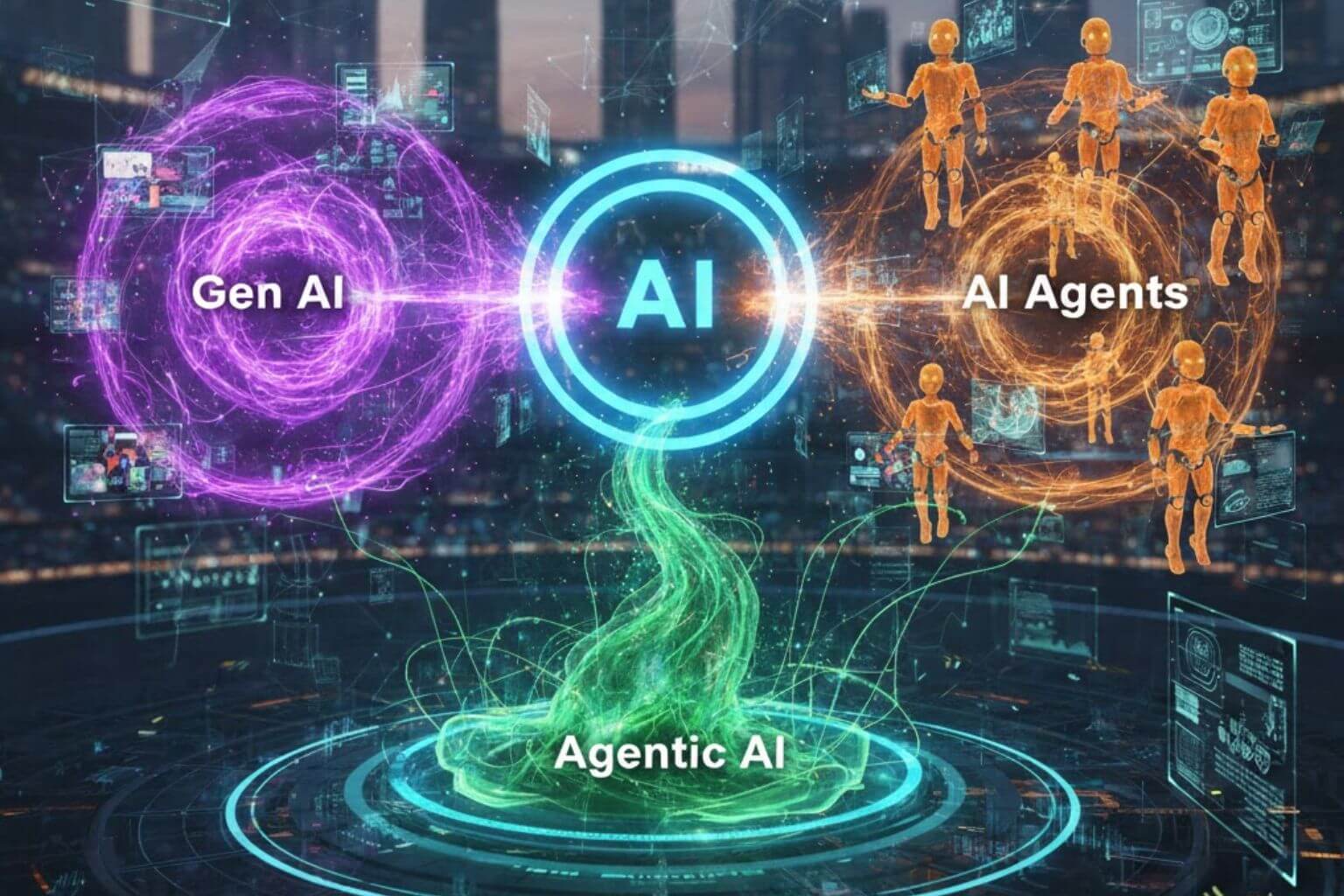
Generative AI: The Creator of Content
Generative AI or Gen AI for short is what most people first used while talking about modern AI. It is the technology that can create new content.
Gen AI can write articles, generate images, draft emails, create code, and summarize documents. It learns from patterns in large datasets and produces outputs that feel humanlike.
Think about how quickly you can now turn an idea into a blog post or a concept into a design. That is Generative AI at work.
The biggest advantage for Gen AI is speed and scale. It helps individuals and companies produce more without increasing effort at the same rate. At its core, Generative AI is about creation. It enhances human creativity instead of replacing it.
AI Agents: The Task Handlers
Now let’s move a step ahead.
AI Agents are designed not just to create, but to act. They can take steps towards completion or reaching a certain definite goal. An AI Agent can search for information, use digital tools, connect with software, and carry out a sequence of tasks. Instead of just giving suggestions, it can help execute them.
For example, while looking at options for a new mobile phone or a laptop, you might ask it to research different sellers, compare diverse offerings, and present recommendations based on your desired needs. The system proactively works toward the outcome.
Businesses find AI Agents valuable because they handle routine processes and reduce manual effort. They help teams focus on strategy and decision making.
If Generative AI is a mind, AI Agents are the hands and feet.
Agentic AI: The Independent Problem Solver
Agentic AI is a more advanced concept and a window to the future.
These systems are designed to work with a certain level of autonomy or self-dependence. They can plan steps, remember past actions, adapt to new information, and work toward goals with limited supervision.
They do not need to wait for commands. Within defined limits, they can decide what to do next.
While Agentic AI domain is still in early stages of development, it points towards a transition to AI that can manage more complex workflows and fast changing situations. In simple terms, Agentic AI aims to make AI more self-reliant.
Why This Matters Today
AI is no longer an experiment for businesses. It is slowly being adapted as part of everyday business operations.
Companies and business organizations use AI to enhance user experience, reduce operational costs, and for faster decision making. From hospitals to banks to online retailers, AI adoption is increasing steadily. Companies that incorporate AI wisely often get a competitive edge. While the ones who keep thinking about the same risk losing business, revenue and the market!
For professionals, the message is loud and clear, understand AI, it is becoming a career advantage!
What You Should Learn to Stay Relevant
If you want to work in the AI space, strong foundations still matter. Programming, statistics, and machine learning basics remain much useful. Going beyond, modern AI roles also require understanding large language models, prompt design, and automation workflows.
But technical skills alone are not enough. Companies value people who understand business needs and can apply AI to solve real problems. The ability to connect technology with practical outcomes makes you far more valuable.
Learning AI today is about blending technical skill with real world thinking.
Industries That Actively Need AI Talent
AI talent is no longer limited to tech companies.
- Healthcare uses AI for diagnostics and research.
- Finance uses it for fraud detection and risk analysis.
- Retail uses it to personalize shopping experiences.
- Manufacturing uses it to predict equipment issues.
- Marketing uses it to tailor campaigns.
- Software companies use it to improve development processes.
The underlying principle is simple. AI saves time, improves accuracy, and supports better decision making.
Jobs and Opportunities in the AI Era
There is a lot of fear around AI and jobs, but the reality is a bit different.
AI is reshaping existing job roles and also creating newer ones. Positions like AI Engineer, Data Scientist, and Machine Learning Engineer continue to grow. Newer roles focused on managing and applying AI systems are also emerging.
Employers increasingly look for people who can work with AI tools confidently. The demand is not just for coders. It is for problem solvers who understand how to apply AI.
Do AI Skills Make Your Job Safer?
AI skills can strengthen your career, but only if you use them in practice.
Real world projects, experimentation, and a strong portfolio matter far more than theoretical knowledge. Continuous learning is important because the AI field keeps evolving quickly.
One thing is becoming clear across industries is that professionals who understand AI have a definitive edge. It is not about competing with AI. It is about learning how to work alongside it.
Conclusion
Generative AI, AI Agents, and Agentic AI show how artificial intelligence is evolving. From creating content, to taking action, to becoming more autonomous.
Understanding these areas helps you prepare for the future of work. AI is not a passing trend. It is shaping how industries operate and how careers grow.
The smartest move is to stay curious, keep learning, and build practical skills.
Start Your AI Journey with DV Analytics
If you want to move from theory to real capability, only structured learning will help you.
DV Analytics focuses on practical training, real world projects, and industry relevant skills in Data Science and AI. The aim is to make learners job ready, not just certificate holders.
Whether you are starting out, upskilling, or switching careers, proper learning can save time and build confidence. The AI driven future is already here.
The right skills can help you be part of the industry.
Interested to learn how DV Analytics can help you? Connect with us today!