 SINCE 2010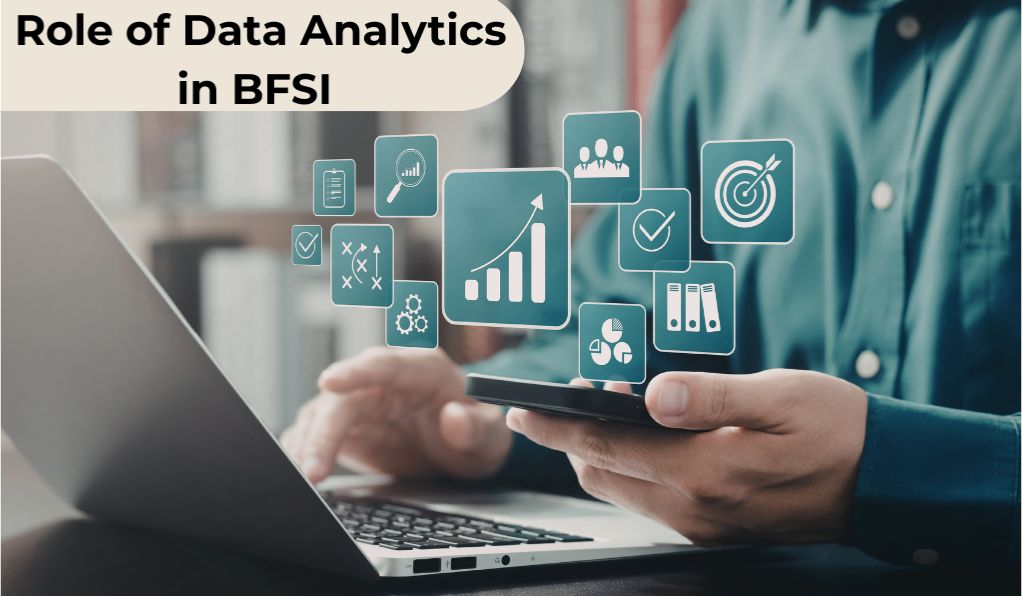
Now a days, a simple data analytics course cannot be your sole objective. One has to equip themselves with Gen AI skills along with Data Analytics to stay ahead of the curve. Gen AI skill has become a game-changer for decision-making in both small and large businesses. The huge amount of structured and unstructured data produced by various devices across different platforms have provided incredible insights.
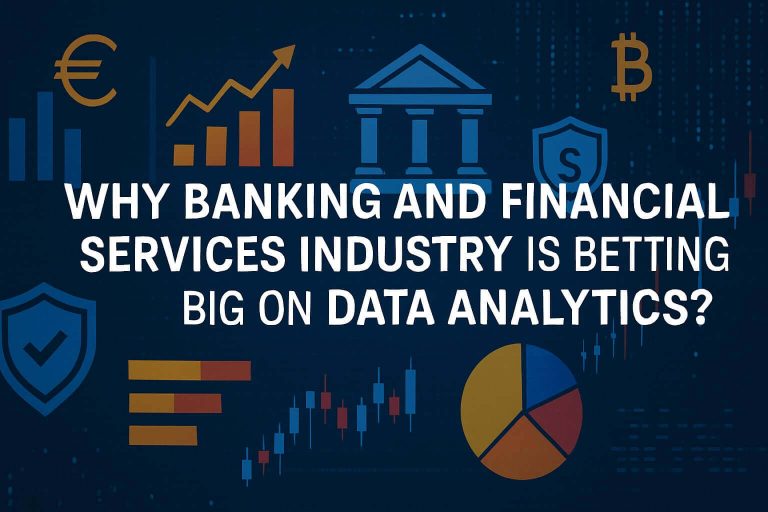
All Thanks to data analytics and effective data management, the Banking and Finance Services Industry (BFSI) has utilised Big Data to optimise organizational prowess as well to ensure risk management, profitable growth, and better performance.
Roles for Data Analytics in BFSI sector?
- Chief Data Officer: This individual ensures that the organization maximizes the value extracted from its data.
- Business Analyst: This role merges analytics knowledge with domain expertise, acting as a vital link between analytics resources and business teams.
- Big Data Specialist: An expert in extracting insights from both structured and unstructured data, enhancing business intelligence.
- Data Literate Workers: Given the significance of Big Data, it’s essential for all employees in the BFSI industry to possess a foundational understanding of data skills.
The Approach to Data Analytics in BFSI
- Decentralized approach: A small team of analysts is stationed for each department of the organization. Eg, few Business Risk Analysts would report directly to the Chief Risk Officer, while Marketing Analysts would connect with the Marketing Head. This approach helps each group to hone in on their specific area of expertise over time.
- Centralized approach: This method involves creating a centre of excellence for analytics. This team, made up of Data Scientists, handles all the important jobs. This also makes sharing best practices much easy while Data Scientists can pick up new skills more quickly.
Key Analytics Techniques Prevalent in the Banking Industry
- Predictive modeling: This field is led by regression techniques such as logistic, linear, etc. Machine Learning is also starting to make its mark here.
- Optimization: Banks always aim to minimize losses while managing risk and maximizing revenue. Both linear and non-linear methods are widely utilized.
- Segmentation: This technique employs algorithms like CART and CHAID, with Random Forest and other Machine Learning methods gaining traction.
A lot of banks even today depend on the legacy systems that operate in isolation, thus making it difficult to implement Machine Learning. While it may take some time to fully harness the potential of Machine Learning, traditional statistical techniques like regression will continue to play a significant role in the banking sector for now.
Big Data Tools Required in the Banking Sector
- Modeling: Modeling in the banking industry is mostly done on tools like R, SAS, and Python. Once SAS used to be the go-to choice for banks, but there was some hesitation to embrace the open-source R code because they couldn’t claim ownership over it. Now, banks are increasingly turning to R and Python, with R seeing a significant increase in usage lately. There are now specialized packages tailored for analysis in the banking sector.
- Optimization: While Excel has been the traditional tool for optimization, R and Python are upping the game. It wouldn’t be a surprise to witness a shift towards R and Python for optimization tasks in the near future.
- Segmentation: SAS E Miner is a popular choice for segmentation, but it is a costly affair. On the other hand, Knowledge Seeker and Knowledge Studio are more budget-friendly options, allowing analysts to create decision trees in a user-friendly, GUI-based environment.
- Visualization and Dashboarding: Tools like Spotfire, QlikView, Tableau, and SAS Visual Analytics have fully transformed this segment. CXO (Chief Executive Officer) dashboards are becoming more insightful than ever. Looking ahead, CXOs will be able to provide a high-level overview while still having the flexibility to dive into the most intricate details.
Challenges in Training Employees for Analytics?
- Different Delivery Models: The secret to effective personalized training lies in choosing the right content delivery models, whether that’s e-learning or instructor-led sessions. Trainees benefit the most when these two approaches are blended. However, instructor-led training can be tricky due to the conflicting schedules of candidates. That’s why we’re offering online training that candidates can access from anywhere.
- Differing Skill Sets: Candidates come with a mix of skill sets, experience levels, and expectations. Training needs to cater to everyone. For instance, some candidates might already be familiar with the basics of data visualization, while others may not have any background at all. Learning Tableau can be a breeze for those who already have a grasp of the basics, but it might be a bit of a challenge for those who don’t.
- Varied modes of training: The training needs to be customized to meet the diverse needs of all participants, aligning with their understanding and experience levels. It should include assignments and projects based on real-world scenarios, as this approach will help learners dive deeper into analytics topics.
Conclusion
In the banking and financial sectors, the primary goals are performance, profitability, and reducing risk. In our data-driven age, achieving performance hinges on Big Data technologies that can handle both semi-structured and unstructured data in real-time.
A Business Analyst course covers essential skills like data modeling, requirement gathering, and optimizing business processes. At times, banks may need to offer loans at lower interest rates to key sectors such as agriculture, housing, and education. They also have to keep an eye on the cash reserve ratio (CRR), statutory liquidity ratio (SLR), repo rate, and other important metrics.
BFSI companies are working hard to streamline operations across all areas. Their goal is to create more efficient systems, improve service delivery and customer engagement, and safeguard these systems from cyber threats. Enhance your data-driven decision-making skills with our Data Analytics course Bangalore, designed to equip you with the in-demand skills needed in today’s job market.
Ready to step into the amazing word of analytics? Contact us today!